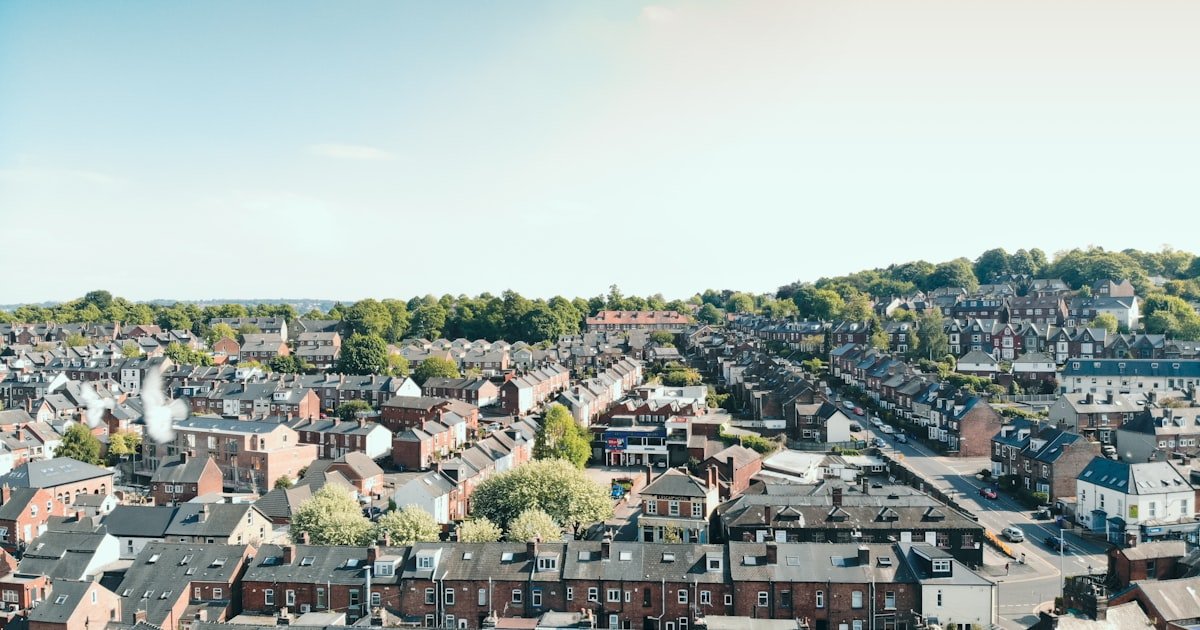
Sheffield property market May 2026, flats vs houses diverging
Sheffield's housing market in May 2026 is splitting in two. Houses, especially semis in family postcodes, are up about 3.5% year on year, while flats are down 1.1%, weighed down by the unresolved cladding and EWS1 backlog. Days-on-market tell the same story: 50 days for houses, 269 for flats. Here is what the latest Land Registry, Rightmove and TwentyCi data tells sellers and investors about the city right now.
Quick answer: The Sheffield property market in May 2026 is splitting by stock type. HM Land Registry UK House Price Index data puts the average Sheffield property at around £222,000 (February 2026), with houses up 3.5% year on year and flats down 1.1%. Days-on-market run about 50 for houses versus 269 for flats. The drag on flats is overwhelmingly cladding, EWS1 and leasehold concerns under the Building Safety Act 2022. If you need to sell a Sheffield flat now, a cash buyer can complete in 7-28 days, for the full local service overview see our sell house fast Sheffield page.
Sheffield property market headline numbers (May 2026)
The headline picture comes from the HM Land Registry UK House Price Index (UK HPI). Because the official local-authority series runs about three months in arrears, the most recent confirmed Sheffield figure available for sellers reading this in May 2026 is the February 2026 release. The April 2026 release at regional level was published on 21 May 2026.
- Average Sheffield property price: around £222,000 (HM Land Registry, February 2026).
- Sheffield houses, semi-detached: approximately +3.5% year on year.
- Sheffield flats / maisonettes: approximately -1.1% year on year.
- Yorkshire and the Humber regional growth: +3.9% YoY in the April 2026 UK HPI release, the strongest English region.
- Days on market (Rightmove / TwentyCi, early 2026): roughly 50 days for houses, 269 days for flats.
- Price-reduced listings (Rightmove, November 2025): Sheffield was the largest UK city for month-on-month rise, up around 50%.
The two big stories are the regional outperformance. Yorkshire and the Humber leading England, and the widening gap inside Sheffield itself between houses and flats. For sellers, the second story matters more, because it determines whether the standard estate agent route will work for your specific property. If you already know you need to move quickly, our Sheffield cash sale service page covers the deeper detail, including the postcodes we buy in and typical timelines.
Houses in Sheffield: the strong half of the market
For owners of family houses in Sheffield, the 2026 picture is roughly what you would expect after a tough 2023-24. Demand for semis and terraces in school-catchment postcodes is steady, mortgage approvals are recovering, and the regional ranking from Land Registry data. Yorkshire and the Humber at the top of England, flows through to local sale prices.
Where houses are doing best
Family-house postcodes in the south and west of the city are leading: S11 (Ecclesall, Greystones, Sharrow Vale), S7 (Nether Edge, Heeley), S17 (Dore, Totley, Bradway), S10 (Broomhill, Crookes, Fulwood) and S8 (Meersbrook, Norton). Walking distance to a strong primary, plus three bedrooms or more, is the main driver. Properties in this segment are typically achieving asking price or close to it, with multiple-buyer competition in the most sought-after streets.
Time on market for houses
Rightmove and TwentyCi figures for early 2026 put the median time-on-market for a Sheffield house at around 50 days. That is roughly in line with the national average and signals a functioning, balanced market for this stock type. Our broader guide on how long it takes to sell a house in the UK sets out the same picture at national level: open-market sales for houses are taking around 5-6 months from listing to completion.
"The 50-day vs 269-day split between houses and flats is the single most useful number for any Sheffield seller in 2026. It tells you which playbook applies to your property."
Flats in Sheffield: the slow half of the market
Flats are a different story. Land Registry data shows Sheffield flat values fractionally below where they were a year ago, and the time-on-market gap is the real signal. Buyers and lenders aren't avoiding flats by accident. They are responding to a stack of issues that haven't gone away since 2017.
EWS1 and cladding under the Building Safety Act 2022
The biggest single drag is the External Wall System (EWS1) form. Introduced in late 2019 after Grenfell, the form was meant as a short-term lender tool. In 2026 it is still in use. Lenders generally require an EWS1 rated A1, A2 or B1 (or confirmation that the building is out of scope) before agreeing to a mortgage on a flat in a medium or high-rise block.
The Building Safety Act 2022 reshaped the legal framework, with section 122 and Schedule 8 introducing the leaseholder protections for "qualifying leases" in 11m-plus buildings. That is genuine progress for affected leaseholders, but it hasn't unblocked the lender side as quickly as anyone hoped. Government guidance on cladding remediation is collected at gov.uk/guidance/building-safety.
Practically, this means Sheffield flat sellers are filtered into three groups:
- Block out of EWS1 scope (usually under four storeys with no external cladding), sales proceed normally, although service-charge and ground-rent concerns can still slow things.
- Block with a valid EWS1 A1, A2 or B1, sales proceed, but pricing is sensitive to the certificate and lender appetite.
- The property and its documents need to be assessed together. Share any survey, repair history, treatment plan, insurance information or title issue with the buyer and your solicitor. We consider properties with complications and explain our proposed terms after reviewing the details.
Park Hill and Hyde Park: the listed-concrete case study
No discussion of Sheffield flats is complete without Park Hill. The Grade II*-listed estate, originally completed in 1961 and partially redeveloped from 2009 onwards, is still in a multi-phase regeneration. Phase 1 leaseholders are a decade in. Later phases are still being built out.
Issues that come up repeatedly for Park Hill sellers in 2026:
- Shortening leases. Some Phase 1 leases have ticked below 80 years, the threshold at which extension premiums rise sharply (the "marriage value" trigger before the Leasehold and Freehold Reform Act 2024 reforms commence in full).
- Service charges. Listed concrete and the wider site infrastructure are expensive to maintain. Lenders look closely at service charge history.
- Lender appetite for listed concrete. Some high-street lenders simply won't lend on listed concrete construction at all, regardless of EWS1.
- Live regeneration. Buyers and surveyors price in the disruption of ongoing works on neighbouring phases.
The property and its documents need to be assessed together. Share any survey, repair history, treatment plan, insurance information or title issue with the buyer and your solicitor. We consider properties with complications and explain our proposed terms after reviewing the details.
Why flats take 269 days when houses take 50
The TwentyCi data point of roughly 269 days median time-on-market for Sheffield flats in early 2026 isn't a fluke. It captures the cumulative effect of EWS1 surveyor caution, leasehold reform uncertainty under the Leasehold and Freehold Reform Act 2024, service-charge inflation, and a buyer pool that has shrunk to those happy with leasehold complexity.
Sheffield postcode performance at a glance (2026)
The picture isn't uniform across the city. The table below summarises the broad pattern by postcode group, based on Land Registry transactions and Rightmove activity data.
| Postcode group | Dominant stock | 2026 trend | Typical buyer |
|---|---|---|---|
| S11, S7, S17, S10 | Family houses, semis | Strong, +3-5% YoY | Owner-occupier families |
| S8, S6, S12 | Terraces, semis | Steady, broadly flat to +3% YoY | First-time buyers, investors |
| S5, S9, S13, S35 | Ex-council, terraces | Mixed, more reductions | Investors, BTL landlords |
| S1, S3, parts of S2 | City-centre flats | Weak, -1 to -3% YoY | Cash buyers, BTL investors |
What Rightmove's November 2025 price-reduction signal told us
In November 2025 Rightmove highlighted Sheffield as the UK city with the largest month-on-month rise in price-reduced listings, up around 50% on October. That figure was widely reported at the time and reflected a specific local dynamic: too many vendors had set spring 2025 asking prices that the autumn buyer pool didn't support, particularly for flats and dated stock.
Six months on, the lesson for May 2026 sellers is straightforward. Asking prices for Sheffield houses can be set with reasonable confidence against comparable sales, the market is active enough to validate them. Asking prices for Sheffield flats need to be set against the realistic mortgageable-buyer pool, not the headline value of a similar-looking unit two years ago. Houses that are on the market too long almost always come down to pricing or condition; for flats, it is far more often a mortgageability issue you can't fix by reducing the price by £5,000.
How interest rates and the Bank of England fit in
The interest-rate backdrop is doing what Sheffield houses need it to do. After the long cycle of rises into 2023 and the holding pattern through 2024-25, base rate has stepped down since late 2025. That has fed into mortgage product rates and supported the recovery in house transactions across Yorkshire. Our Bank of England base rate history guide tracks the full cycle.
Lower borrowing costs help houses more than flats in Sheffield, because the flat-side block is structural, not affordability. A 1% drop in mortgage rates doesn't solve an EWS1 problem. It does help a family stretch from a smaller house in S8 to a slightly bigger one in S7 or S11.
What this means if you're selling in Sheffield in 2026
If you own a house in Sheffield
The property and its documents need to be assessed together. Share any survey, repair history, treatment plan, insurance information or title issue with the buyer and your solicitor. We consider properties with complications and explain our proposed terms after reviewing the details.
If you own a flat in Sheffield
The first question is mortgageability, not price. Before listing, get clear answers from your management company on EWS1 status, lease length, service charge history and any planned major works. If the block is out of EWS1 scope and the lease is comfortable, you can sell through an estate agent, expect a longer marketing period than houses and pricing sensitivity. If the block has an EWS1 issue, a lease below 80 years, or active major works, mortgaged buyers will be limited and a cash buyer is often the realistic route. We cover that scenario for Sheffield in detail on the sell house fast Sheffield page.
If you've already had a sale fall through
This is unfortunately common with flats in 2026. The buyer's lender pulls out at survey or on the EWS1 question, and you're back to square one, often after weeks of waiting. Our guide on what to do when a house sale falls through covers the immediate next steps. The short version: with a flat, a re-listing through the same agent is unlikely to fix the underlying issue.
Investor takeaways from May 2026
For buy-to-let investors and portfolio holders, the Sheffield split has two clear implications. First, family-house stock in solid postcodes is competitively bid and yields are tight. Second, the flat segment looks superficially cheap, but mortgageability and forward service-charge risk mean the cheapness is often genuine compensation for a real problem. Investors comfortable with cash purchase and longer-term remediation can find pockets of opportunity, particularly in well-managed blocks with valid EWS1 forms.
Sheffield rental demand remains underpinned by two strong universities, the AMRC and Olympic Legacy Park, and a steady graduate-retention pattern. Yields on smaller terraces in S5, S6 and S8 typically hold up well against many comparable UK cities.
Frequently asked questions
According to the HM Land Registry UK House Price Index for February 2026 (the most recent confirmed local-authority figure published before May 2026), the average property price in Sheffield was around £222,000. The April 2026 release shows Yorkshire and the Humber as the strongest performing English region at +3.9% year on year.
The divergence is driven mainly by the unresolved cladding and EWS1 backlog under the Building Safety Act 2022, plus rising service charges and ground-rent concerns. Houses (especially semis) in Sheffield are up around 3.5% year on year while flats are down about 1.1%. Lenders' surveyor caution on medium and high-rise blocks is the single biggest factor.
Rightmove and TwentyCi data show median time-on-market for Sheffield houses around 50 days in early 2026, compared with roughly 269 days for flats. The gap reflects buyer hesitation around leasehold, cladding, and the EWS1 process for mid-rise blocks. Cash buyers aren't affected by EWS1 in the same way as mortgaged buyers.
The property and its documents need to be assessed together. Share any survey, repair history, treatment plan, insurance information or title issue with the buyer and your solicitor. We consider properties with complications and explain our proposed terms after reviewing the details.
Rightmove's November 2025 market analysis identified Sheffield as the UK city with the largest month-on-month rise in price-reduced listings, up around 50% on October. That figure reflected the gap between asking prices set in spring 2025 and the slower autumn buyer pool, particularly for flats and dated stock.
Yes. The Building Safety Act 2022 (specifically section 122 and Schedule 8 leaseholder protections) and the EWS1 surveyor process introduced in 2019 continue to slow sales of medium and high-rise leasehold flats. Lenders generally require either a valid EWS1 rated A1, A2 or B1, or evidence that a block falls outside the form's scope, before agreeing to a mortgage.
Family-house postcodes in the south and west of the city: including S11, S7, S17, S10 and parts of S8, are leading on price growth and time-on-market, supported by school catchments and limited family-house supply. City-centre flat-dominant postcodes (S1, S3 and parts of S2) are the weakest, weighed down by leasehold and cladding issues.
If you can wait, the longer-term outlook for sound leasehold stock in Sheffield is reasonable, with cladding remediation continuing under the Building Safety Act 2022. If you need to sell now: for relocation, divorce, probate or financial pressure: a cash buyer can complete in 7 to 28 days, sidestep the EWS1 mortgage-survey problem, and give you a fixed completion date.
The HM Land Registry UK House Price Index release covering April 2026 shows Yorkshire and the Humber as the strongest performing English region at +3.9% year on year, ahead of the North East, North West and East Midlands. London remained the weakest, with annual growth close to zero. Sheffield's house segment is broadly tracking the regional average; the flat segment is lagging.
Selling a house or flat in Sheffield?
We buy houses and flats across all S postcodes: including blocks affected by EWS1, leases under 80 years, and Park Hill. We price every property on what it actually is and on what you tell us, so there is no percentage formula and the figure we give you is our best offer at that point. It only changes if conveyancing turns up something material, such as a title defect or a structural problem, or the property turns out to be different from how it was described. Written offer the same day, valid for 14 days, and completion in 7 to 28 days.
See our Sheffield service